Intelligent Aeration
DO
AutoDO-driven or scheduled
New diffusers and paddlewheels — or retrofit what you have.
Executive Briefing · Aquaculture Technology
Shrimp Enterprise Resource Planning
Powering Ecuador's #1 export industry with solar energy, intelligent aeration, and fully automated farm operations — independence from diesel, grid-electric, and from manual error.
01 — At a Glance
A 675-hectare operation — some 70 four-hectare pools — runs on diesel aeration that cannot be automated: costly to run, impossible to monitor, blind to control.
14 HP Chinese diesel motors driving 16-paddle wheels — the industry standard.
Low-performance generation: 8–10 kWh per gallon on paper, less in the field.
Multiplied by roughly 350 motors, burning diesel every hour they run.
| Per 4-hectare pool | 16HP Diesel aerator | SherpSPS solar powered | 16HP Electric grid paddle |
|---|---|---|---|
| Unit cost | $3,000 | $40,957 | $4,000 |
| Useful life | 3 years | 8 years* | 3 years |
| Maintenance / month | $50 | $10 | $10 |
| Reliability | 80% | 95% | 50% |
| Units per pool | 5 | 1 | 6 |
| Energy cost / year | $26,325 | $0 | $2,527 |
| Total cost / year | $34,906 | $5,240 | $7,741 |
| Total cost / 10 years | $349,063 | $52,396 | $77,411 |
| vs SherpSPS, annual | 666% | — | 148% |
| 10-year saving with SherpSPS | $296,666 | — | $25,014 |
Assumptions: 13 air-hours per day · 0.3 gal/hr · $5.00 per gallon · 90-day cycles, 3 per year · grid at $0.12 per kWh · 35% profit margin
* SherpSPS useful life conservatively set at 8 years, including equipment repositioning
Over ten years, a single 4-hectare pool burns $349,063 on diesel aeration. SherpSPS runs the same pool for $52,396 — a saving of $296,666 per pool.
The diesel unit is cheap to buy and ruinous to own: five motors per pool, replaced every three years, fed $26,325 of fuel a year — with no way to automate, monitor, or control any of it.
Total operating cost per 4-hectare pool, 10-year span
This is not the exception — it is the operating standard. And it is being rewritten.
Cost and energy management are the key.
Drives operating cost and exposes every crop to fuel logistics.
Caps production capacity — or inflates cost through wasted motor performance.
Operations are never optimized; every cycle depends on a person and the farm on that person.
Pollute ponds, increase mortality, and damage the surrounding environment.
Geopolitical shocks land directly on the farm's P&L.
Introduces inconsistency, missed cycles, and human error at scale.
An integrated Enterprise Resource Planning system built specifically for shrimp farming: energy, aeration, feeding, sensing, and operations control in a single cloud-connected platform.
New diffusers and paddlewheels — or retrofit what you have.
Modular solar + BESS per aerator. No grid needed.
Scheduled feeding aligned to the shrimp's natural rhythm.
Power, aerators, feeders, and sensors in the cloud.
Continuous readings feeding automation and analytics.
HaLow radio + Starlink, up to 1,000 devices.
Charts, reports, and exportable data on demand.
Everyone sees exactly what their role allows.
Works even over low-bandwidth farm networks.
Above the hardware sits the ERP layer: strategic and tactical tools for production management, turning every pond into a measured, controlled, and improvable asset.
SHERP is not a concept — it is running on live farms. Below, the actual platform: real-time monitoring, per-pond telemetry, schedule design, and AI-assisted operations.
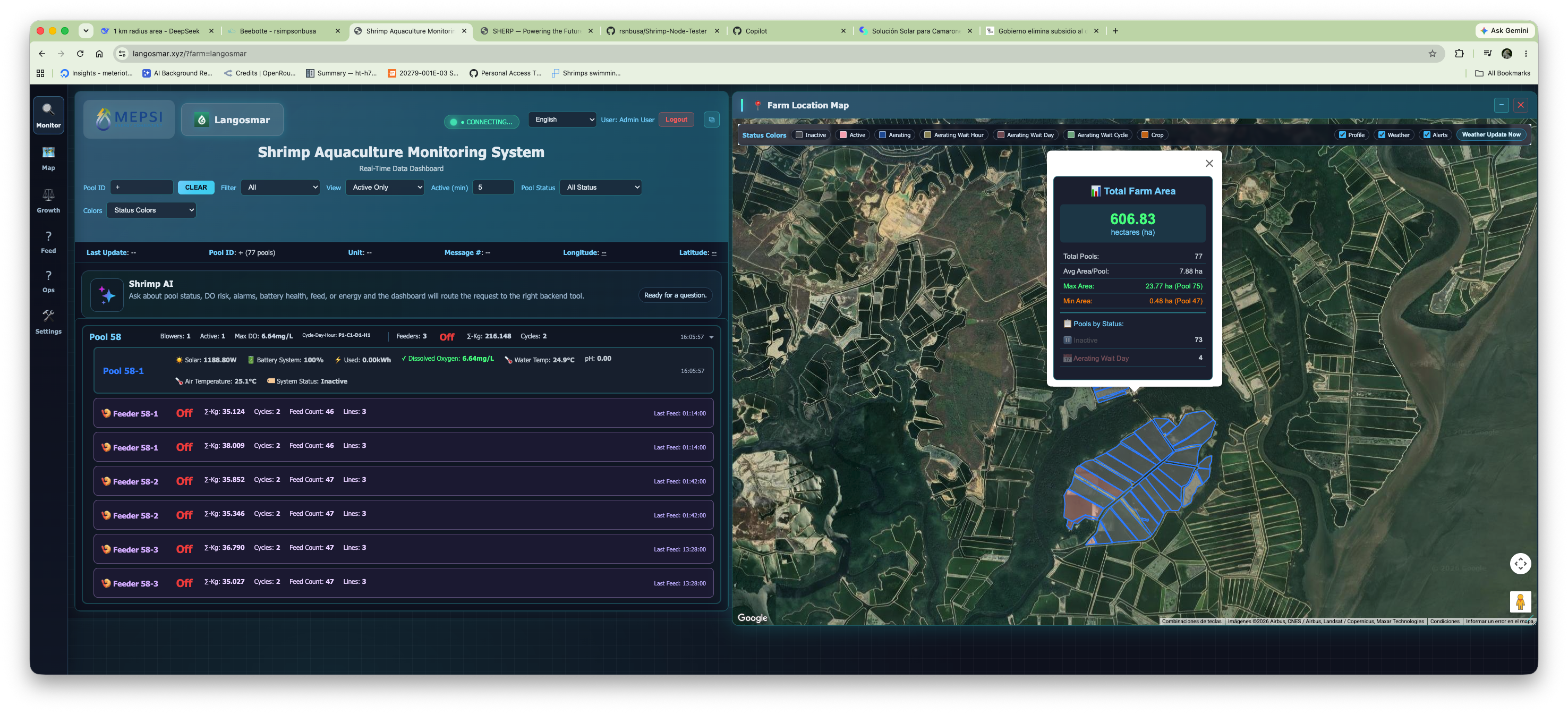
Every pond, aerator, and feeder on one screen — live status, satellite farm map with pool-by-pool state, and 600+ hectares under continuous supervision from anywhere.
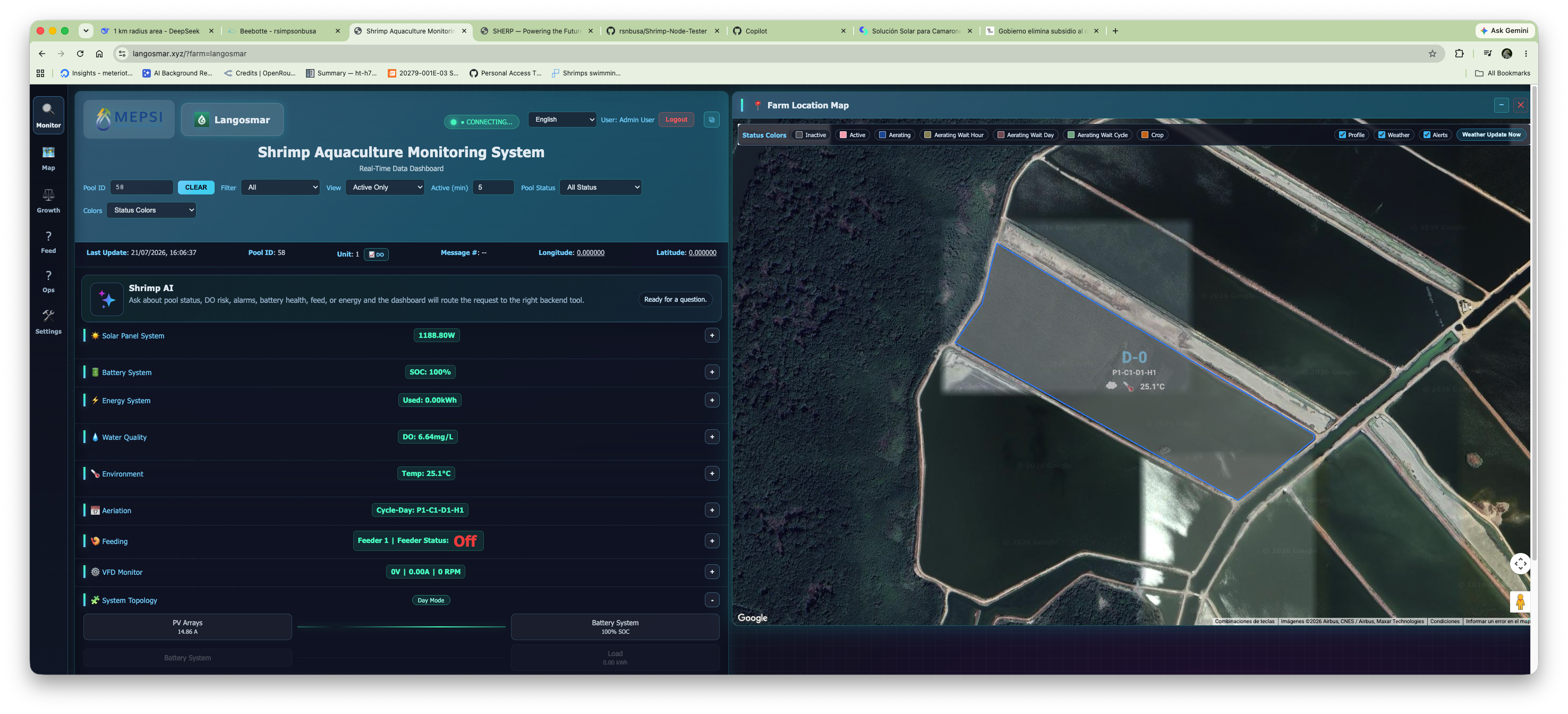
Solar output, battery state of charge, dissolved oxygen, water temperature, aeration cycles, and feeder state — per pond, in real time, down to the individual device.
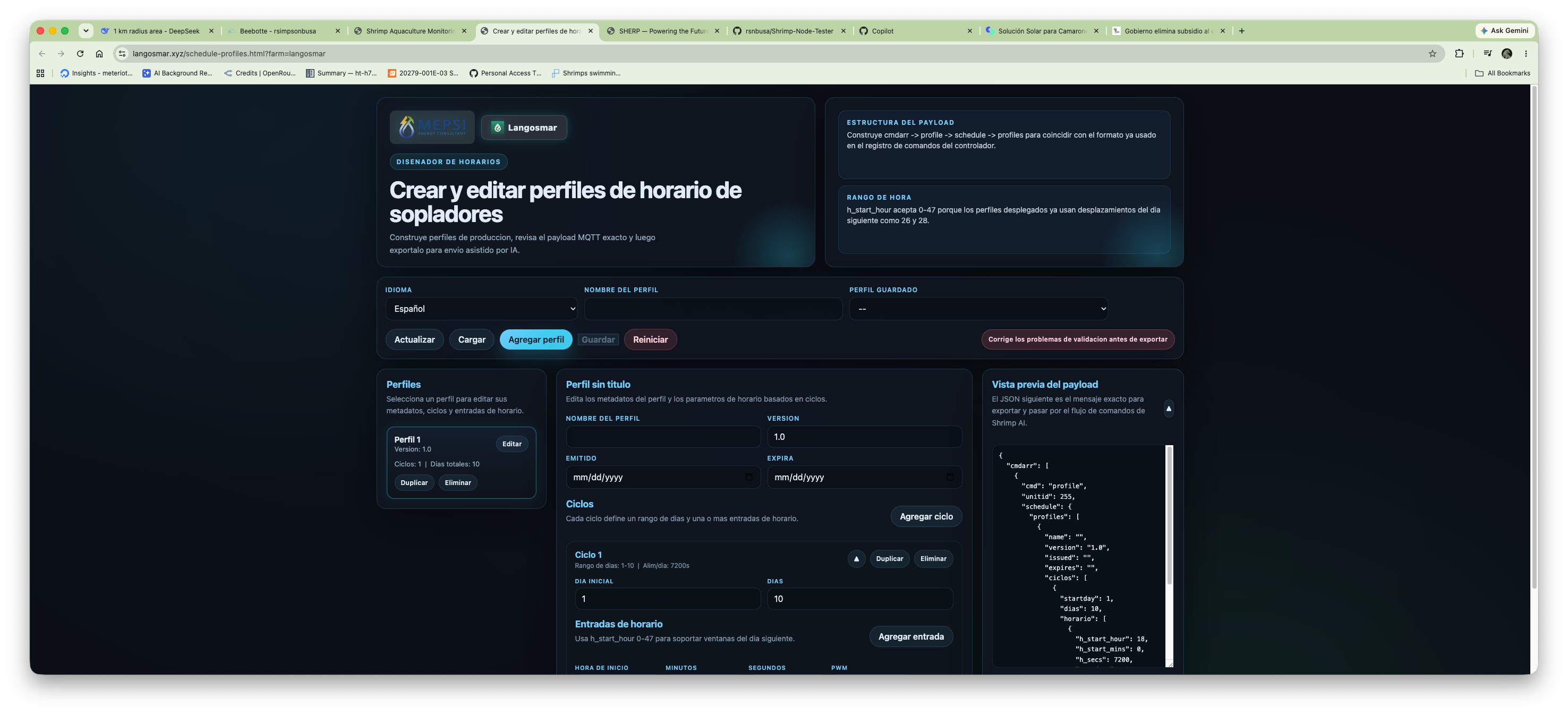
Aeration and feeding profiles built cycle by cycle, versioned, and dispatched to the field over MQTT. Multilingual by design — shown here in Spanish, as used by farm staff.
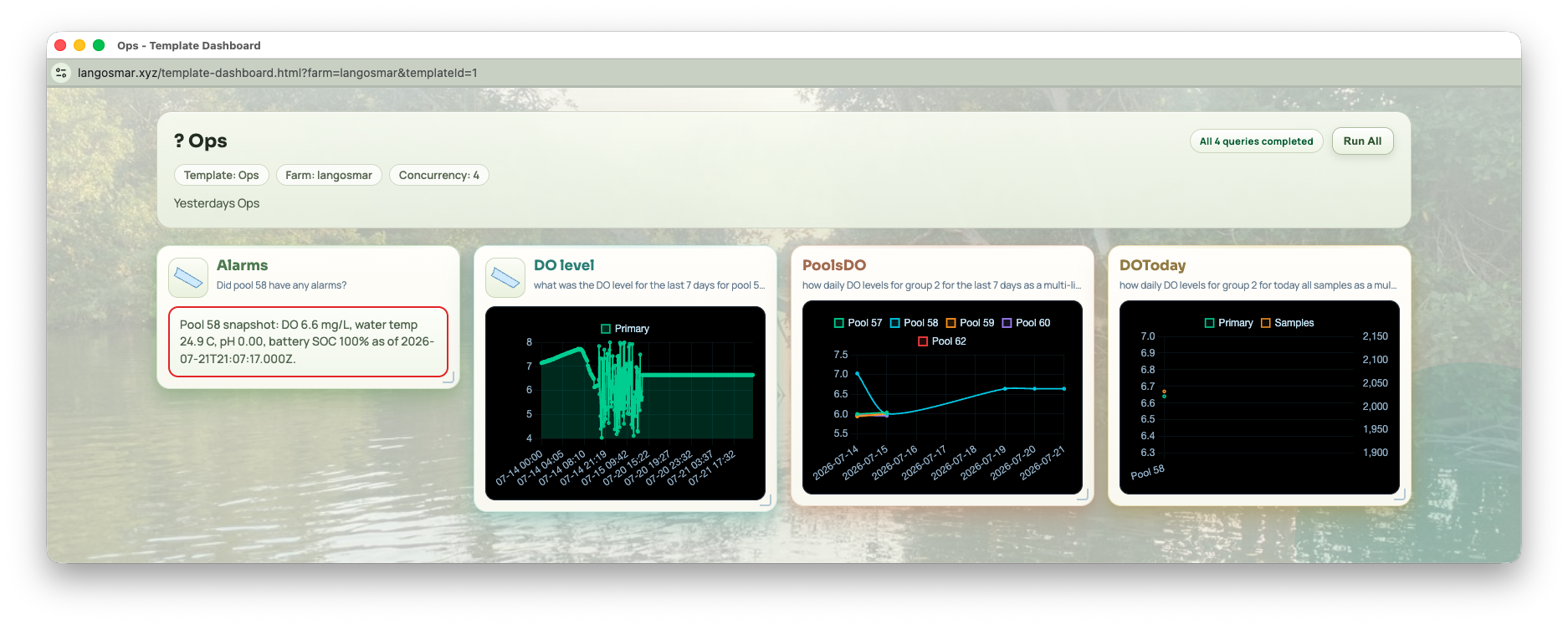
The AI assistant answers in plain language and charts: alarms, DO trends per pool or group, energy summaries. Queries become reusable report templates, shared across working groups — each user with exactly the access their role permits.
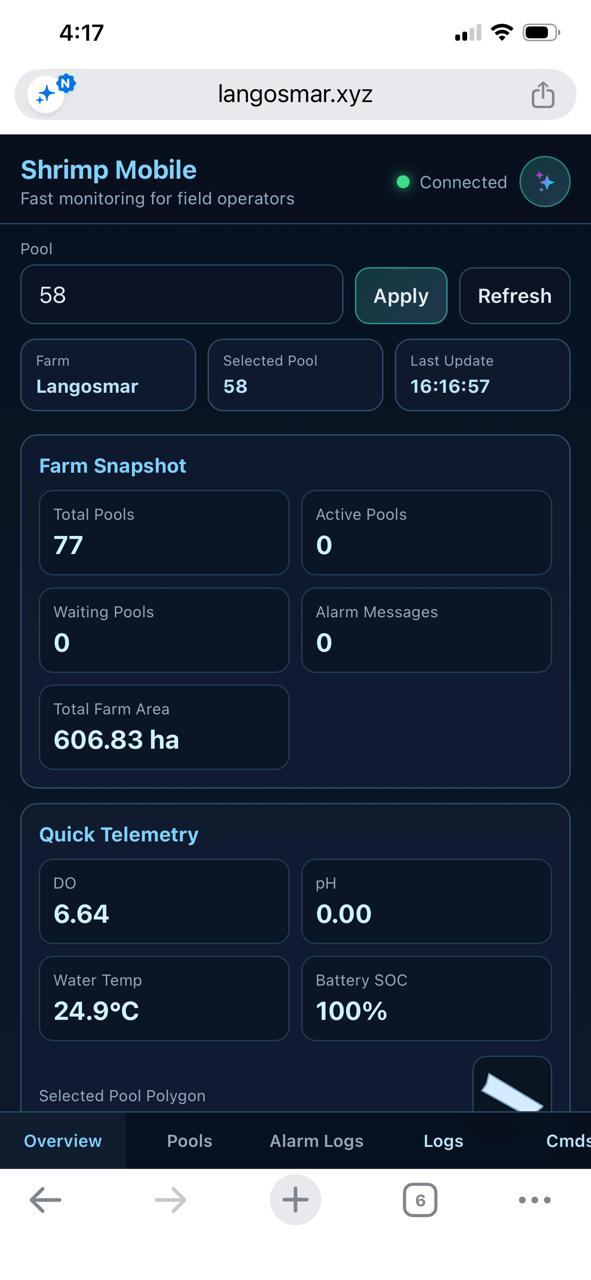
A lightweight mobile interface gives field staff and managers the most important information at a glance — pond status, alarms, energy — even over the farm's low-bandwidth HaLow network.
No more staff walking pond to pond.
No 3 a.m. manual restarts ever again.
Schedules resume on their own, on the shrimp's rhythm.
Change strategy per season — not in the field.
No missed restarts, no inconsistency at scale.
Analytics sharpen aeration and feeding over time.
08 — Market Opportunity
+223.5% total increase (2022→2026)
Diesel price per gallon — 2022 to 2026 escalation trend
Verified project assumptions and operating data; detailed substantiation is available through the due-diligence materials.
09 — Investor Proposition
For investors and financial institutions, SHERP presents a uniquely de-risked opportunity within the high-growth aquaculture technology sector. Our financial model is built on guaranteed repayment, flexible partnership structures, and a stable macroeconomic environment.
09.1 — Business models
Every deployment is monetized through one of two simple structures. In both cases the farm pays SHERP on a fixed schedule; the difference is only who owns the equipment at the end of the term.
SHERP owns the equipment. The farm pays a recurring lease for predictable access — no upfront capital required.
The farm buys the system on a payment plan, amortizing the equipment cost over an agreed term of monthly installments.
09.2 — Repayment structure
Every sale the farm makes carries a contract with its buyer stating that payment goes to the Trust Fund — not to the farm. Established in a reputable national or international jurisdiction, the Trust disburses predefined amounts through a fixed waterfall:
09.3 — Financial alternatives
Investors participate through three instruments — from fixed-income style lending to equity upside.
Expected ROI: ≥18%
Secured project loans for farm systems, backed by the equipment and expected savings, with principal and interest repaid through the Trust Fund.
A direct equity stake in the project vehicle for strategic partners seeking long-term profits and transparent distribution of proceeds.
A variable, growth-linked return based on measurable outcomes such as energy savings or increased production.
Where each instrument sits
09.4 — Currency risk mitigation
Ecuador's official currency is the U.S. Dollar. Sales, costs, repayments, and distributions are conducted in dollars, eliminating FX volatility and making long-term forecasting more predictable for international investors.
The farms cannot wait for the grid.
The industry cannot afford diesel.
SHERP is the solution.